
Garage Door Spring Replacement in Jacksonville
A snapped spring is the most common garage door failure, and the most dangerous to DIY. We replace it safely, usually the same day.
Spring Replacement
Fast, Safe Spring Replacement
Your garage door springs carry the entire weight of the door. Most are rated for around 10,000 cycles, which goes quickly when your garage is the main way you enter your home. When a spring breaks, the door becomes heavy, won’t open, or slams shut, and it should not be operated until it’s fixed.
Our technicians carry pro-grade torsion and extension springs and complete most replacements in about an hour.
Schedule Spring ReplacementOur Services
Signs Your Spring Is Failing
Door Won’t Open
The opener strains or the door won’t budge because the spring can’t counterbalance the weight.
Loud Bang
A sharp bang from the garage is often a torsion spring snapping.
Visible Gap
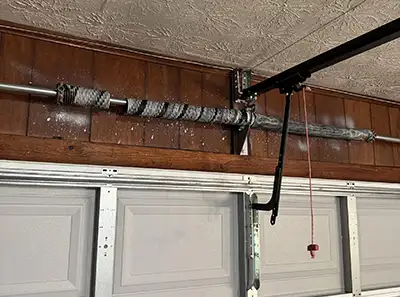
A two-inch gap in the coil is a clear sign a spring has broken.
Door Falls Fast
A door that drops quickly or feels very heavy by hand is unsafe to use.
Crooked Movement
One-sided or jerky movement can point to an extension-spring failure.
Cables Loose
Slack or tangled cables often accompany a broken spring.
Why Action
Why Leave Springs to a Pro
Springs are under extreme tension and can cause serious injury if handled improperly. Our certified techs have the tools and training to do it safely, and we replace in pairs so your new springs wear evenly.
- Certified, insured technicians
- Pro-grade springs (not builder-grade)
- Replaced in matched pairs
- Full safety & balance check included
- Same-day service available*
High Cycle Spring Upgrades
Most doors come from the factory with standard springs rated for 10,000 cycles, which works out to roughly 2 to 5 years depending on how often the door gets used. We offer QuietBuilt springs, our high cycle upgrade rated for 30,000 cycles, backed by a 10 year warranty. It costs a little more up front, but you’re not paying for another standard spring in a few years. Over time, that usually works out cheaper, not more expensive. We’ll walk you through the option on site, there’s no pressure either way.
Torsion Springs vs. Extension Springs
Most Jacksonville garage doors use one of two spring systems, and knowing which one you have helps explain what’s actually going on when it fails.
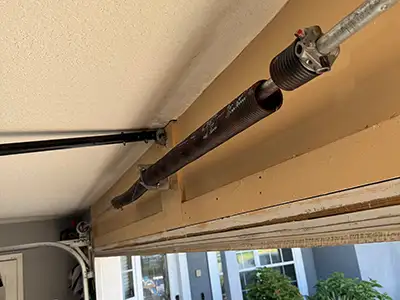
Torsion springs sit on a metal bar mounted horizontally above the door. As the door closes, the spring winds up and stores energy, then unwinds to help lift the door back open. Most residential doors use one or two torsion springs, depending on the door’s weight.
Extension springs run along the horizontal tracks on either side of the door and work by stretching and contracting. They’re common on older Jacksonville homes and tend to be a bit less expensive, but they carry a real safety trade-off, without a safety cable running through them, a snapped extension spring can turn into a projectile. We always check for safety cables and add them if they’re missing.
Either type, when one goes, we recommend replacing both springs at the same time, even if only one broke. They wear out together, so leaving the older one in place usually just means a second breakdown, and a second service call, a few months down the road.
Why We Replace in Pairs
This gets asked a lot, so here’s the honest reasoning: springs on a system with two springs are matched to work together. When one fails, the other one has typically logged the same number of cycles and is close behind it. We don’t do single spring replacements on a two spring system, it’s a safety call for our technicians as much as anything else, an old spring paired with a new one wears unevenly and puts more strain on the door and the person working on it. Replacing both at once keeps the door balanced and keeps the job safe.
Why Springs Break in the First Place
A spring doesn’t usually fail because something went wrong, it fails because it reached the end of its working life. Knowing what shortens that life helps you plan for the next one instead of being surprised by it.
- Normal wear. Most springs are rated for around 10,000 cycles, which is only a few years on a busy garage.
- Rust and humidity. Florida moisture corrodes the coil and weakens the metal well before its cycle rating.
- Skipped maintenance. An un-lubricated, out-of-balance door makes the spring work harder on every cycle.
- Wrong size spring. Builder-grade or mis-matched springs are under-rated for the door’s weight and fail early.
- Temperature swings. Repeated expansion and contraction fatigues the steel over time.
- Age. On an older door, the spring is often simply the oldest working part left.
Spring Replacement Across Duval, Clay & St. Johns Counties
Broken springs don’t stop at the county line, and neither do we. Our trucks cover Jacksonville and the Southside, Mandarin and Julington Creek, Orange Park, Fleming Island and Middleburg in Clay County, and Ponte Vedra, Nocatee and St. Augustine in St. Johns County.
Techs carry pro-grade torsion and extension springs on the truck, so wherever you are in Northeast Florida, most broken-spring calls are finished on the first visit, usually the same day.
Frequently Asked Questions
Is it normal for garage door springs to break?
How long does it take to replace a broken spring?
Is it safe to replace a garage door spring myself?
Do I really need to replace both springs, or just the broken one?
What causes a spring to break in the first place?
Explore All of Our Services
A Broken Garage Door Spring Isn’t a Wait-and-See Problem
Call now or book online, and we’ll get it fixed safely, usually the same day.